
Cinematography for the Sphere
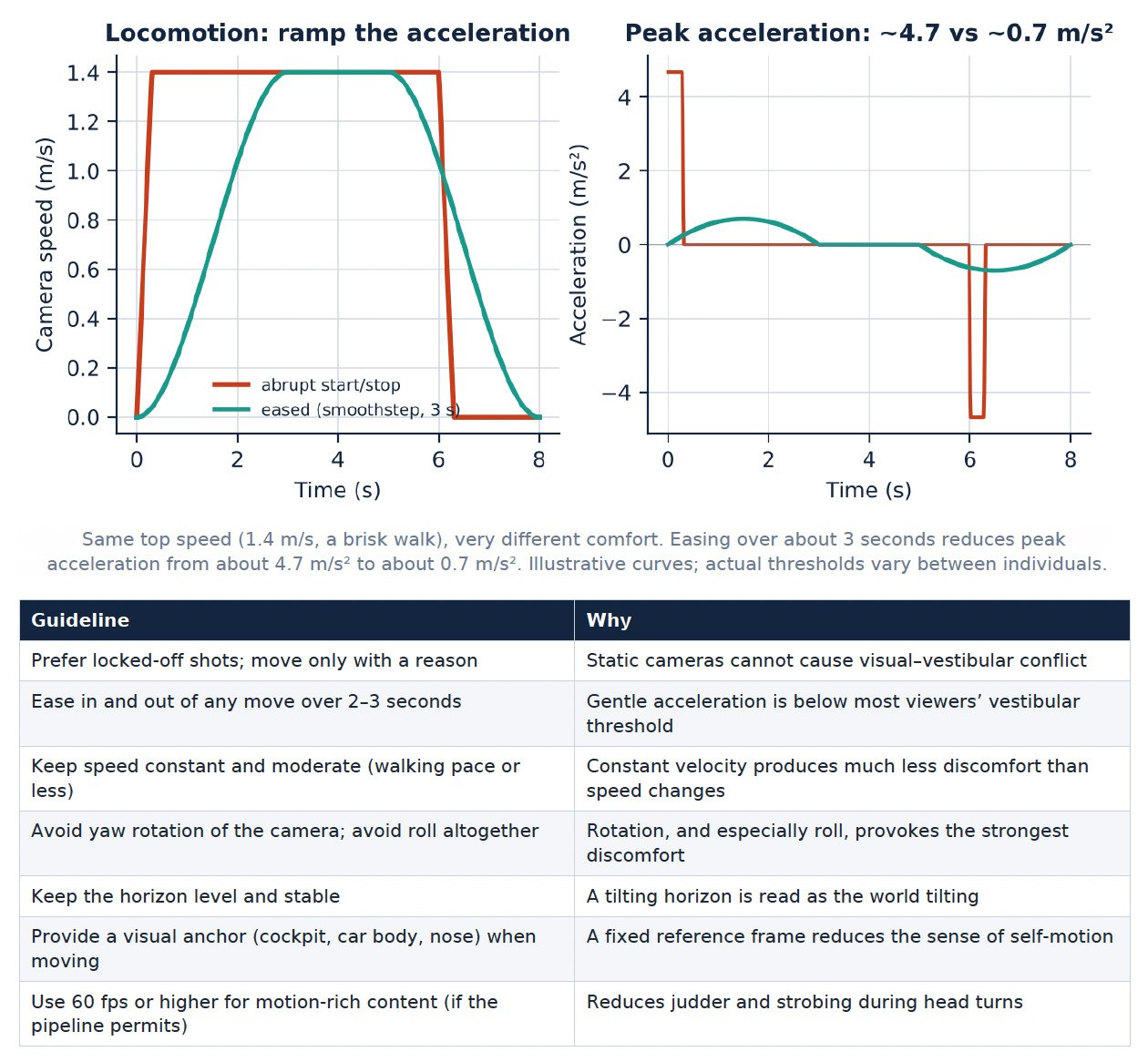
Why some camera moves feel fine in 360 and others don’t
In a headset, the viewer’s eyes travel with the camera while their body stays in a chair. Comfort depends on how well those two reports agree, and they disagree most while the camera is changing speed.
Ride the camera move
Both moves take the camera from rest to walking pace, 1.4 m/s. Pick one and watch what the eyes see next to what the inner ear feels.
The inner ear’s acceleration sensor
0.0
m/s² it would feel if the move were real
0.0
m/s² it feels in the viewer’s chair
Mismatch right now: 0.0 m/s²
The otolith organs of the vestibular system work like the weighted sensor above: a real push bends them, and the brain reads the bend as acceleration. (The semicircular canals do the same job for turns.) They respond to changes in speed, not steady speed. At a constant glide they would be upright even if the viewer really were moving, so eyes and body can agree. While the camera speeds up, the eyes report a push the body never feels.
Camera speed over time
- Abrupt ramp
- Gentle ramp
- Your ramp
Acceleration: what the eyes see and the body doesn’t feel
- Abrupt: peak 4.7 m/s²
- Gentle: peak 0.7 m/s²
- Your ramp
- Inner ear feels 0 m/s² throughout
- Ramp length
- Peak acceleration
- Compared with gravity
- How it begins
The bands are illustrative, not clinical thresholds. Sensitivity varies a lot between viewers.
How the ramp changes comfort, and why
- Peak acceleration sets how hard the conflict hits.At 4.7 m/s², the picture lurches forward at nearly half the force of gravity while the viewer’s otoliths register nothing. That reads as a jolt. At 0.7 m/s², closer to a train easing out of a station, the disagreement is small enough for many viewers to absorb.
- Curvature sets how the conflict begins and ends.A straight ramp switches acceleration on and off in an instant, which adds a small kick at each end of the move. Curving the ramp lets the acceleration build and fade instead. The cost is a higher peak: a full S-curve peaks 50% higher than a straight ramp of the same length, so a curved ramp needs a little more time.
- Ramp length sets how long the conflict lasts.A longer ramp lowers the intensity but stretches the mismatch over more time. A very long, drifting speed change can be as tiring as a sharp one, which is why some VR comfort guidance prefers changes that are brief. Aim for gentle but purposeful.
- Steady speed is the comfortable part.Once the camera holds a constant speed in a straight line, the inner ear has nothing to contradict. Discomfort clusters around starts, stops, speed changes and turns, so fewer of them means a calmer shot.
- What this means on set.Move in straight lines at a steady pace, ease in and out rather than snapping, avoid repeated speeding up and slowing down, and consider cutting into a shot that is already moving so the viewer never sees the acceleration at all.