360 Fundamentals
One of the biggest challenges when working with 360 cameras is planning around the stitch lines, the gaps between the cameras where the software has to try to fill in the gaps.
This problem is compounded depending on the device and use case; the more lenses, the more stitch lines are present, and ideally the gap between the lenses should be kept to a minimum.
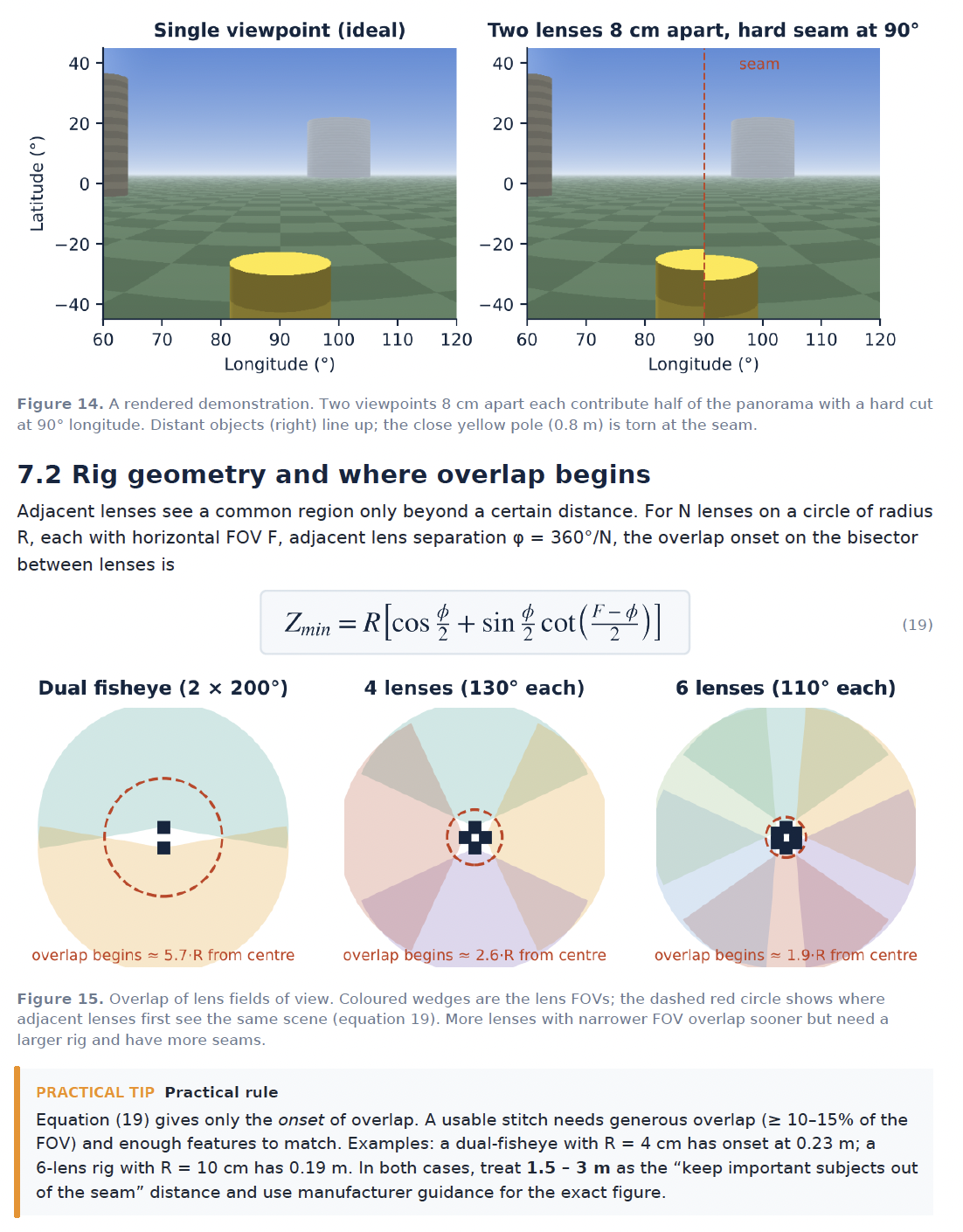
360 camera lenses are fisheye lenses designed to capture maximum horizontal and vertical range, with the edges being pinched and more heavily distorted. There is often a minimum safe distance subjects can stand from the camera to reduce the stitchline issue when subjects pass these points and so when shooting we have to plan productions accordingly.
360 Stitch line and overlap tool
Simulate spatial blocking, calculate multi-object safety metrics, and identify critical parallax blind spots before entering the set.
Actor A (Primary)
Object B (Prop)
Stitch Seam Line
Focal Sweet Spot
Set Safety Diagnostics
CLEAR RUN
Analyzing spatial parameters...
Scene Preset Selector
Camera Rig Spec
Actor A (Green) & Movement Vector
Object B (Purple)
Tripod Base Footprint
360° Dual-Crew Spatial Planner
Simulate structural stitch lanes alongside an environmental 2-node column array to track safety metrics for multiple field technicians concurrently.
Crew Hub Alpha (Blue)
Crew Hub Beta (Pink)
Structural Stitch Seams
Structural Pillars (1-2)
Camera Array Configuration
Crew Station Alpha (Blue)
Crew Station Beta (Pink)
Environmental Obstacle Array
Obstacle Pillar #1
Obstacle Pillar #2
Integrated Analysis Engine
CREW A STATUS
CREW B STATUS
Compiling matrix parameters...
360° Spherical & Cubemap Engine
Deconstruct game engine architectures. Observe how traditional 2D master maps transform concurrently into immersive spherical fields and 6-sided cubic environments.
2D Flat Equirectangular Input File (2:1 Ratio)
Interactive 3D Preview Sphere (With Zoom)
Rendered 6-Sided Cross Cubemap Map Layout
Cubemap Architecture (Game Engines): Notice how the cubemap layout forms a clean structural cross. Cubemaps divide a 360° scene into 6 flat perspective camera boxes (Front, Back, Left, Right, Top, Bottom). Game engines (like Unity and Unreal) use cubemaps because processing flat squares is significantly faster for a computer than calculating continuous spherical trigonometry curves!
The Science of the Seam
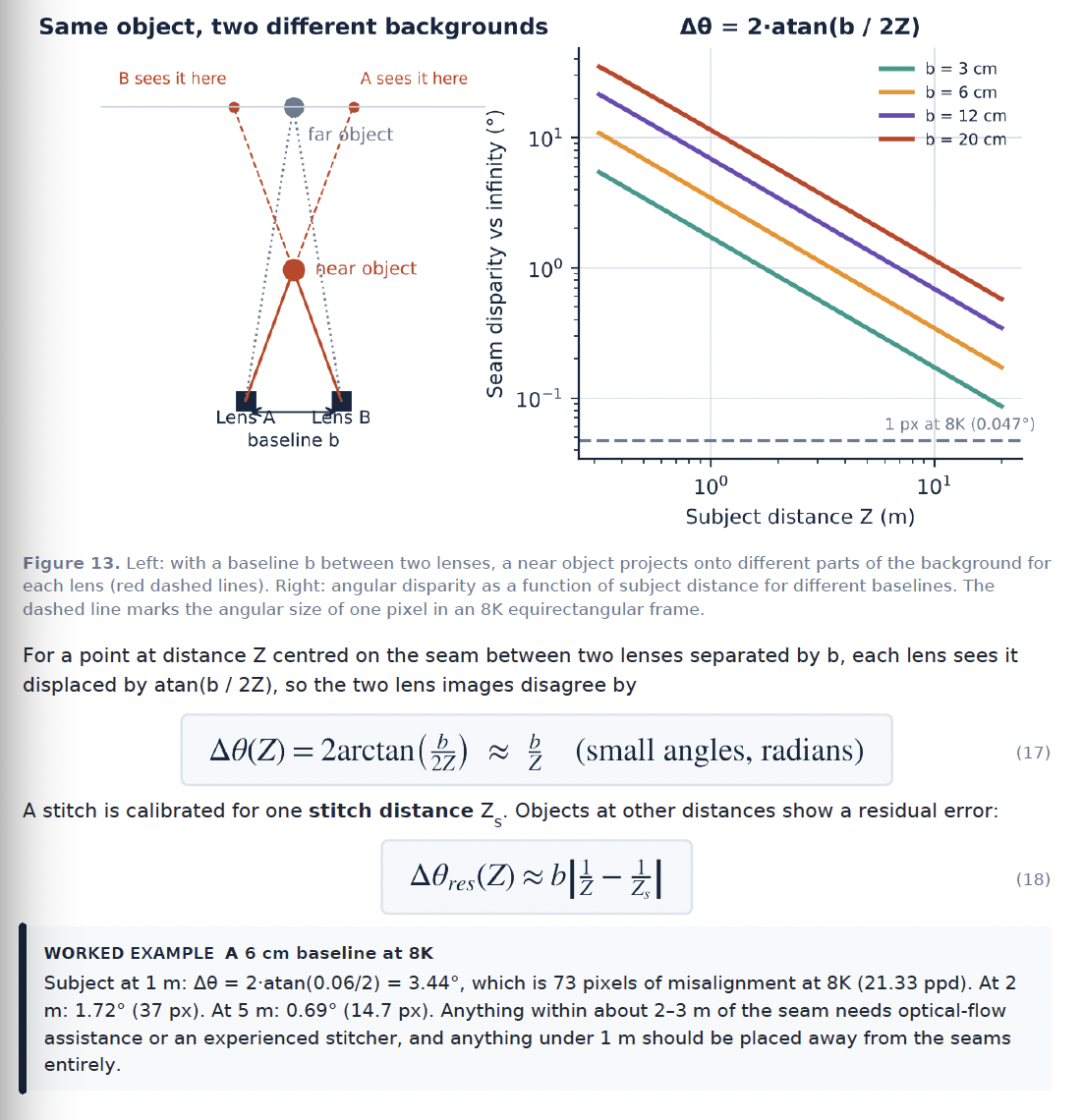
In order to correctly align every lens we need to understand the geometry of every lens: intrinsics (focal length, principal point, lens distortion) and extrinsics (the rotation and translation of each lens) where the overlap takes place and the distance between them. This is why we would calibrate our camera dependent on the position, distance and model of camera used.
There are techniques to aid in correcting stitch line errors where parallax issues are also created, this is done through a process known as Optical flow blending whereby the stitching software estimates a dense motion field between the two overlapping crops and warps halfway towards each other then blends.